

(SeaPRwire) – Project Hail Mary succeeds largely due to the relatability and likability of its protagonist, Ryland Grace (played by Ryan Gosling). Both Andy Weir’s 2021 novel and the new film adaptation by directors Christopher Miller and Phil Lord leverage Dr. Grace’s underdog appeal to ensure the high-stakes mission to save the planet resonates emotionally as well as intellectually. Although Project Hail Mary is categorized as “hard” science fiction, its triumph hinges on humanistic themes and the audience’s affection for Grace as a selfless savior. However, a late-game revelation shifts the perspective on Grace, and beyond the extraterrestrial action, a specific twist ultimately defines the conclusion of Project Hail Mary.
Below is an explanation of the conclusion of Project Hail Mary: detailing how a preceding twist alters the entire narrative, and why author Andy Weir asserts that this plot element was integral to the story from its inception.
Warning! Major spoilers for Project Hail Mary follow.
Explaining the Ending of Project Hail Mary

The conclusion of Project Hail Mary shows Ryland Grace residing on the planet Erid alongside his alien friend Rocky (voiced by James Ortiz). The Eridians have constructed an enclosed biodome for Grace, featuring a beach and ocean. This differs slightly from the novel, where Grace’s habitat on Erid was more modest and he was significantly older. Additionally, the film implies that his vessel, The Hail Mary, could potentially return to Earth, a possibility not hinted at in the book.
Nevertheless, mirroring the book’s finale, Grace is educating young Eridians about science, effectively continuing his former profession as a middle school science teacher. This results in a heartwarming conclusion, which stands in stark contrast to an earlier revelation in the film—a darker moment that exposes Grace’s lack of bravery in the past.
The Importance of the Ryland Grace Twist

Throughout the movie, much like the novel, Grace suffers from partial amnesia resulting from a prolonged induced coma and specific substances administered by Stratt (Sandra Hüller). The narrative structure of the book mirrors the film: as Grace recalls events on Earth preceding the mission, the audience gains insight simultaneously. The most shocking revelation is that Grace initially outright refused the suicide mission, fleeing from authorities and requiring to be forced into the coma that launched him into space. According to Andy Weir, the creator of Project Hail Mary, this moment—depicting Grace as a coward in the past versus a hero in the present—was a pivotal plot point essential to making Grace a multi-dimensional character.
“I wanted to establish a foundation of an almost pathological fear of conflict within him,” Weir explains to Inverse. “He starts off as a somewhat lonely individual without close friends or acquaintances. Eventually, he finds someone he cares about deeply enough to risk his life for.” Weir is alluding to the connection between Grace and Rocky, a friendship that catalyzes Grace’s transformation into a hero. Since the story is not told linearly, the audience discovers later that Grace initially resisted the call to adventure, a realization that retroactively highlights his growth into a braver, more selfless individual.
Joseph Campbell’s monomyth theory outlines the “hero’s journey,” which typically includes an early moment where the character initially declines the adventure. Known as “Refusal of the Call,” this trope is seen when Luke Skywalker complains to Obi-Wan Kenobi in Star Wars (1977) that he “can’t get involved,” only to be thrust into the conflict after his aunt and uncle’s death. Similarly, this technique explains why Frodo attempts to return the Ring to Gandalf in The Lord of the Rings, and why the Doctor in Doctor Who often appears grumpy and dismissive initially.
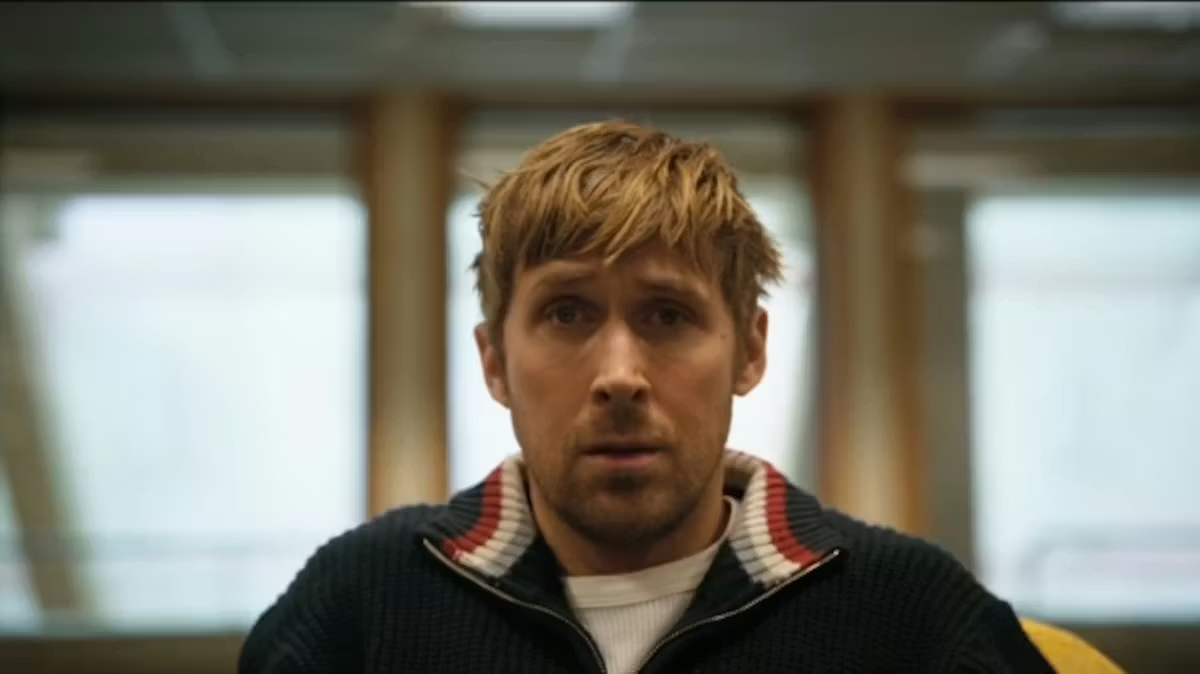
In Project Hail Mary, Grace also resists the call to adventure, though the audience learns of this resistance retroactively.
“He resisted the call, but the call ultimately overcame his resistance,” Weir states. “He didn’t make the choice to go.”
Ultimately, Ryan Gosling’s charisma only goes so far. Grace is humanized by the realization that many of us would react exactly as he does in the flashback: by running away.
“I believe we can all relate to feeling overwhelmed, unqualified, and frightened,” Weir remarks. “That was my goal. It is vital that we empathize with the protagonist, care about them, and root for their success.”
With Ryland Grace and Project Hail Mary, Weir accomplished this objective and more. While one might call this a classic storytelling device, its execution in the film results in a revelation that is both shocking and emotionally poignant.
This article is provided by a third-party content provider. SeaPRwire (https://www.seaprwire.com/) makes no warranties or representations regarding its content.
Category: Top News, Daily News
SeaPRwire provides global press release distribution services for companies and organizations, covering more than 6,500 media outlets, 86,000 editors and journalists, and over 3.5 million end-user desktop and mobile apps. SeaPRwire supports multilingual press release distribution in English, Japanese, German, Korean, French, Russian, Indonesian, Malay, Vietnamese, Chinese, and more.